Consent that cannot be read
How consent works in the interface, why it goes unread, and what can change without breaking requirements.
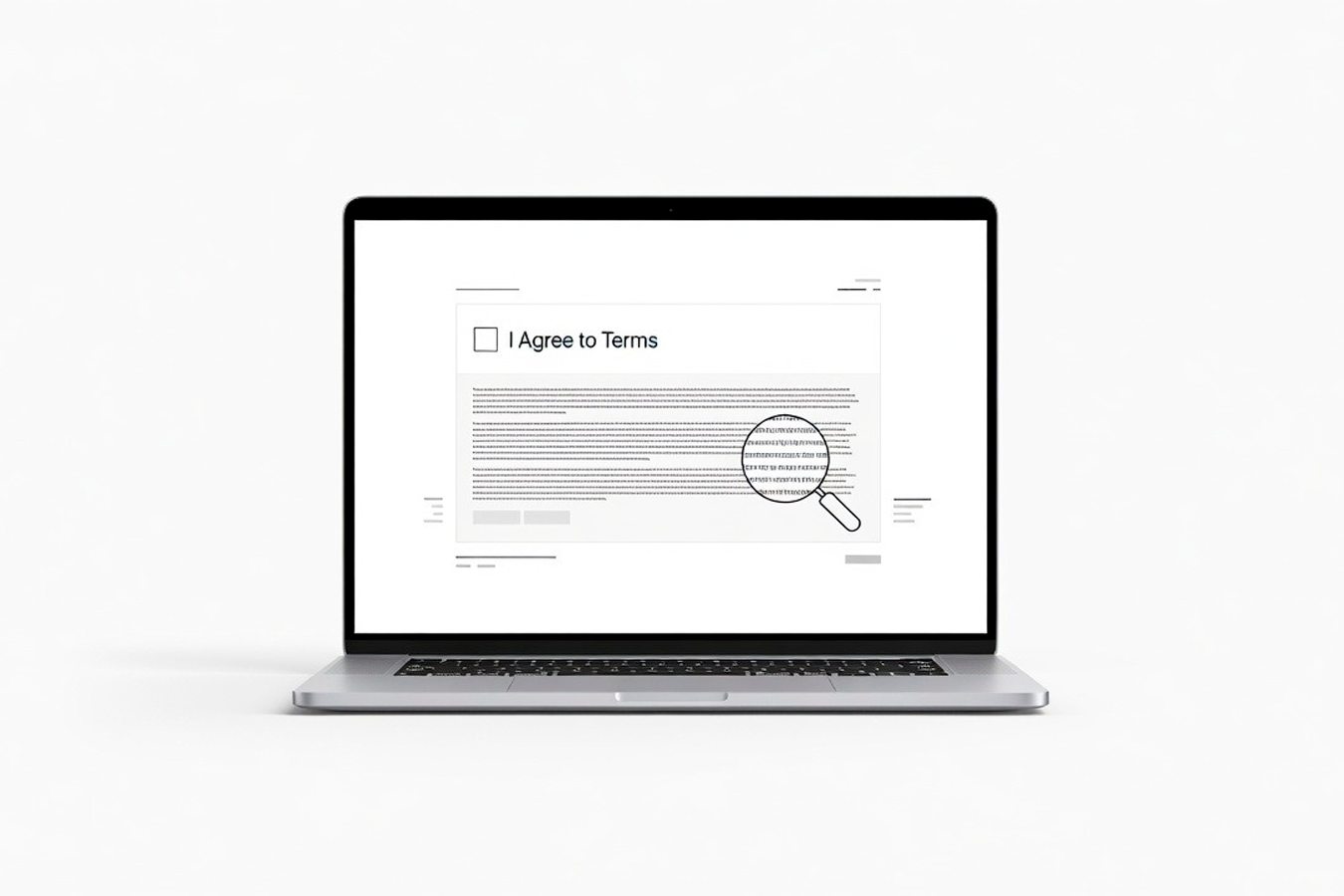
Consent is the one place where a legal document becomes an interface element. Usually the move happens without translation: text written for an auditor is shown to a person who wants a newsletter.
What stands behind one checkbox
Legally, consent splits into at least four parts: purpose, scope of data, term and recipients. In the interface it is almost always reduced to one action and one link.
Fact
In Russian practice consent to personal data processing rests on Federal Law No. 152-FZ "On Personal Data". Requirements for the content of consent are set by the law itself, not by design practice.
Interpretation
Hence the typical failure: the designer treats consent as a legal obstacle and tries to make it invisible. The lawyer treats it as protection and tries to make it complete. Both strategies produce text nobody reads.
What can be shown before the click
- One line about purpose: why exactly this data and what happens next.
- Scope: which fields leave and where they go.
- A link to the full document — next to it, not instead of it.
This does not replace the document. It makes its meaning visible at the moment of decision.
Accessibility as part of consent
The source states
The WCAG 2.2 specification states requirements for controls to be perceivable and operable — including target size, visible focus and clear labels. Consent is a control like any other.
The practical consequence: the consent checkbox cannot be smaller than other tap targets, and its label cannot be the only place where the meaning of the action is disclosed.
Opposing view
An objection we accept: expanded consent takes space and lowers form conversion. We have not tested this on a sufficient sample and do not claim the opposite.
Four parts worth separating
Break consent into its parts and it becomes clear which one is buried deepest. Usually it is the recipients: exactly what a person cannot see before the click.
| Part of consent | Where it usually sits | Where it belongs |
|---|---|---|
| Purpose | In the document, paragraph 2 | One line next to the checkbox |
| Scope of data | In the document, appendix | A caption under the form fields |
| Retention term | In the document, section 5 | In the document — but with a visible date |
| Recipients | In the document, if named at all | One line next to the checkbox |
What this looks like in practice
On this site the consent works like that: one line about purpose, one saying the data is used only for correspondence, and a link to the full document next to it. Nothing hidden behind an ellipsis; the checkbox is the same size as every other tap target.
Interpretation
We do not consider this a solution. It is a minimal honest implementation — a convenient base for testing the next hypotheses.
Editorial conclusion
Readable consent is not about text length but about when its meaning is shown. The full document stays, but stops being the only carrier of information.
Sources and notes
-
Федеральный закон № 152-ФЗ «О персональных данных»
Законодательство РФ · 2006
Links lead to the authors’ own materials. QVORIX publishes original texts, summaries and analysis; third-party materials are not republished in full.
About the author
QVORIX editorial
Collective author of the studio